First posted 2 December 2021 on IMD intranet,
posted 12 November 2023 on possib.li.
There can be no doubt that military personnel exposed to combat face extreme forms of stress. Starting in the 14th century BC when Assyrians in Mesopotamia (1300-609 BC) recorded how their soldiers were dealing with Post-Traumatic Stress Syndrome (PTSD)-like symptoms. And Plutarch’s Life of Marius speaks of Caius Marius’ (157-86 BC) behavior who, when he found himself under severe stress towards the end of his life, suffering from night terrors, harassing dreams, excessive drinking, and flashbacks of battlefield situations1.
Medical organizations have accordingly tried to understand the acute stress forms of Post-Traumatic Stress Syndrome (PTSD), Combat Stress Reaction (CSR), Traumatic Brain Injury (TBI), or suicidal tendencies to help their personnel cope with them.
A large portion of the self-help tools developed specifically for military personnel are available to their families and friends who want to understand what their close ones are going through in order to support them. The US www.military.com site describes the Combat Stress Reaction (CSR) for spouses whose partners may be impacted the symptoms as ”exhaustion, decrease in responsiveness, hesitancy and uncertainty, feeling like you are disconnected and inability to focus. Combat stress reaction is generally short-term and should not be confused with acute stress disorder, or post-traumatic stress disorder, even though some of the symptoms are similar in nature.”2
The military also face everyday stress forms more familiar to business people. US Department of the Army research indicates for example that 40% of its military personnel perceived a great deal or a large amount of work-related stress. 3
And family-related stress impacts both enlisted women (30%) and men (20%) with a significant gender related difference. In the words of the same researchers, it could indicate differences in men’s and women’s level of responsibility for childcare or household duties, perhaps leading to role overload or role conflict for women balancing a career in the military with lives at home.
Interestingly, stress associated with such events did not significantly affect the capacity to function at work for women but it did for men. Apparently, military men were up to 20% less able than military women to manage family-related stressors so that they did not negatively affect work.
Also, two thirds of the women said they experienced at least some (30%) to a great deal (30%) of stress from being a woman in the military. The nature of such stress and the underlying factors contributing to it may be a result of features of military life, the challenges of competing in a predominantly male organization, problems of unwanted sexual advances or harassment by their male counterparts, the result of relatively poor coping skills, or some combination of these or other factors.
To help its enlisted members identify stress, the UK army notes that the « signs and symptoms of stress often develop slowly over time – so slowly that we may not be fully aware of them until they become severe. You may start going through each day ‘mindlessly’, living on autopilot and doing things by force of habit, with no real motivation. Or you may experience physical symptoms like poor sleep or stomach pains. It’s important to be familiar with your own ‘stress signature’ (the unique set of symptoms that you experience in times of stress) so that you can recognise when outside help is needed. » 4
The following table provided by the UK army to its soldiers and their families helps them “recognize that you are stressed, and identify what kind of stress it is”. I view it as a self-diagnosis tool that scans six areas of our well-being: mood, attitude, sleep, physical health, social activity, and alcohol habits. Rating each from healthy, reacting, injured to ill, we get a green-orange-red light result quite similar to the dashboards we like to show in our business meetings.
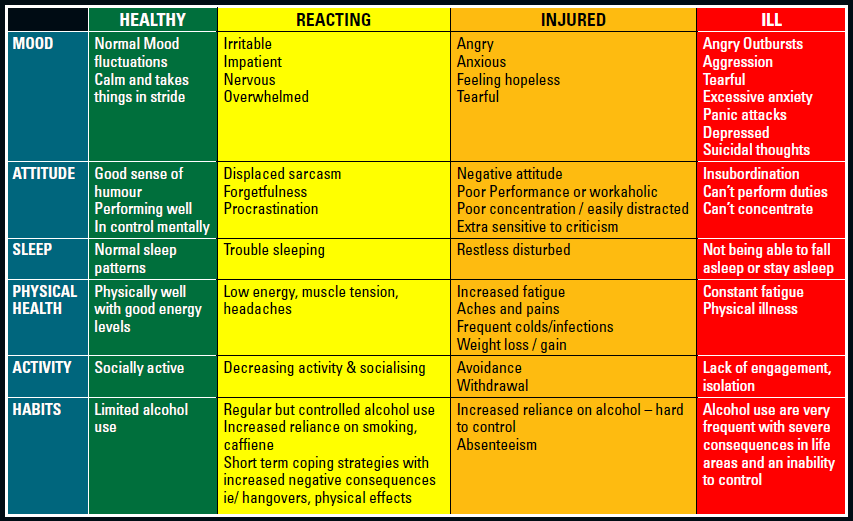
Stress Awareness: STRESS CAN LOOK AND FEEL DIFFERENT FOR EVERYONE.
https://www.army.mod.uk/umbraco/Surface/Download/Get/13490
Understanding that certain moods and behavior we take for granted are in fact not normal is a first step to taking control over them. It will not end the suffering by itself, but it is a first step to reach out for further help. I will not address here how the military provide this support but will just hint that the transparent communication of the military on stress reflects the openness and solidarity I witnessed on army on-line platforms where soldiers and their families share experiences and support each other in ways I have seldom seen in business.
Sources
(2) https://www.military.com/spouse/military-life/wounded-warriors/combat-stress-symptoms.html
(3) https://www.ncbi.nlm.nih.gov/pmc/articles/PMC2883251/
(4) https://www.army.mod.uk/people/join-well/managing-stress/
 Serious Matters Simply
Leave a comment