First posted 6 October 2021 on the IMD intranet.
My first thought waking up early morning was about the purchase order that the customer had not sent on the day we had agreed. It was the last step of an intense 4-month negotiation, and the document was the last thing needed to close the deal and book it. The cloud software subscription would then start immediately and the implementation teams across 4 countries would start the project on time.
Why am I obsessing about the missing PO (purchase order)? I know it will come eventually, but we were getting close to quarter-end, which meant that every delay increased the risk the deal would slip to the next quarter. And that is something that you want to see happen when you are in sales.
I remembered IMD professor Alyson Walter’s 2-step approach to manage stressful situations and decided to apply it here: First identify my stress signature and then draw up an action plan.
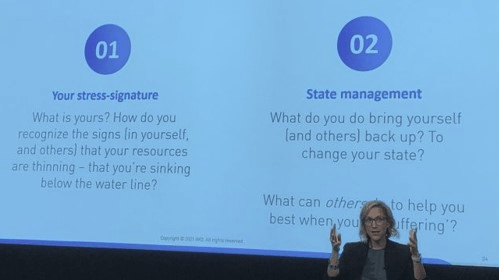
Step 1 – My stress-signature: What do I think in my head, feel in my heart, and do with my hands?
Head
I’m ruminating the same ideas over and over again:
-Why did the key person do this to me? He let me down, personally…
-We had a good connection, how can he be so unreliable?
-I should have foreseen that. Why did I commit to the closing date? But then I had to have a closing date, and it seemed realistic, and…
Heart
I’m hurt. It’s only business and not personal, I know, I know, but still…
Also, I take personal ownership for this slippage.
And my pride of being a reliable closer takes a hit. Again, that hurts too.
And telling myself that I should not be stressing that much for this does not help either: it stresses me even more.
Hands
I moved all the levers I could think of: calling contacts up and across the hierarchy, emailing them, sending text messages to influencers at undue hours.
The silence at the other end only increased my activity level.
Step 2 – Action – Intentional Recovery: What can I do to bring myself back-up? What can others do to help?
Regulate my physiology
Hitting the mountains outside my office on my gravel bike does it for me every time. Pedaling up there requires all my energy and focus, I cannot think about the PO or about much else for that matter.
Mindfulness
Pausing to recognize my stress signature in step 1 helped me understand what is really happening.
Without judging myself or my business partners I see 2 processes, ours and the customer’s, each running side-by-side and trying to find touch points to interact at the right times. Like a pair of dancers who each dance to a different tune.
Do something physical
I chose gardening – Pulling out weeds for a couple of hours. That really switched my brain off the work issue (and it’s real weeds, by the way).
Connect Emotionally
Taking time to ask for help, to listen and to let myself be heard is more difficult for me than biking or than reflecting on what is happening.
I spoke to colleagues about what a pain the whole affair was, but more in an “us vs. them” mode. The more helpful connection was to go back to the customer and expose my frustration. I opened up and told the person how I was feeling. After that particular discussion, I felt I had connected emotionally with the customer, and that we had somehow reset the relationship on a new trust level. We both knew what had to be done, and did not have to second guess each other anymore.
That phase of the process remains a high point for me and I would not have taken it without the conscious 2-step approach.
Find meaning
Develop and practice gratitude and look for purpose. Hmm, not sure how to approach meaning with my stress-case.
I really do not see the meaning of this on a first level. After all, in 3-months time no one will care whether the deal was closed in Q3 or in Q4. Yes, what I do is important, it paves the way for the customer’s digital strategy and all their processes will eventually run on this platform. But while that matters more than the closing date, it does not yet provide the higher purpose.
OK, I’ll go back to my personal mission, which is to “inform people so that they can make better choices”, and that resonates with the case at hand. The events were linked to informing people. Helping them make better choices also means letting them decide for themselves what to do and when to do it.
This part of the process is even more difficult for me than connecting emotionally, and I’ll keep working on it.
So, did it work?
This kind of situation repeats itself over and over for myself and for my colleagues. And it consumes a lot time, emotions, people, health and motivation that could be better used. I did many postmortem or debriefing sessions to figure out what went wrong and how we could do better the next time. And yes, we did improve, but I feel we focused mainly on things, on the “To Dos”, and had not addressed enough the mental state of the people involved including me.
Looking at my mental state for the past few days and applying the 2-step approach liberated me from mulling over failure and allowed me to ask for help. And just that makes a huge difference.
So, does it work? It definitely does for me 🙂
P.S. The PO was sent by the customer as I was finishing this text.
Credits
Alyson Meister is Professor of Leadership and Organizational Behavior at IMD Lausanne.
 Serious Matters Simply
Leave a comment